Frame
Niche behaviorStart from a repeatable interaction and a specific audience, then define a rights-safe original angle.
GeoSports is a daily sports-geography game. Its founder reports assembling the first shareable version over a weekend with Claude and later reaching about 700K monthly active users. This source-backed case study separates Claude's reported role from the distribution, audience, and monetization factors that cannot be isolated.
Start with a narrow behavior and audience, write a bounded product spec with an AI assistant, ship a no-install daily loop, verify that people return and share, instrument the behavior, recruit aligned hosts, and add monetization only after repeat usage survives.
Case-backed workflow; revenue, traffic, subscribers, build time, and channel attribution are Founder-reported.
Results and operating figures on this page are attributed to the cited source case. AI LinkBase has not independently audited them, and they are not a forecast for another product.
This case-backed workflow was selected for evidence quality and transferable operating value, not commission potential. The cited product and vendor links are direct official or primary-source links in this candidate. If AI LinkBase later introduces a tracked commercial link, it must be labeled, must not be presented as part of the founder's historical stack unless sourced, and must not change the recommendation or evidence status. Disclosure details
Prices reviewed Official Anthropic, Vercel, Upstash, Stripe, MapLibre, GeoSports, and U.S. App Store pages checked September 28, 2026; usage, tax, region, domain, ad, and store fees vary. · Full Stack reviewed September 28, 2026
Decision profile
Eight connected capabilities move from a narrow behavior to staged monetization. The order matters more than any individual service.
In brief: frame the behavior, specify the loop, make sharing native, earn the next-day return, then add distribution and monetization.
Start from a repeatable interaction and a specific audience, then define a rights-safe original angle.
Translate the interaction, data, states, edge cases, and launch boundary into a written spec.
Make the first core action playable from the same surface where discovery happens.
Store questions, scores, streaks, leaderboards, accounts, and payments with replaceable services.
Turn completion into a compact result people can post to feeds and group chats.
Give everyone the same bounded challenge and a clear next-session reason.
Invite credible participants to contribute within a reviewed template and reach adjacent audiences.
Protect the free habit loop and measure net revenue after fees, churn, and content cost.
Source case
GeoSports is a daily sports-geography game created by sports storyteller Frank Michael Smith. In the direct founder interview, Smith describes studying MapTap's core interaction, writing a specification with Claude, building a web-first playable version over a weekend, privately testing whether people shared it, and then distributing it through his sports audience. The product later added daily hosts, advertising, subscriptions, and a broader GeoGames mobile app. This page reconstructs the operating sequence without treating AI-generated code, the founder's audience, or reported revenue as universally transferable proof.
In brief: the product is live; its business outcomes, build-time claim, traffic mix, and causal story remain Founder-reported.
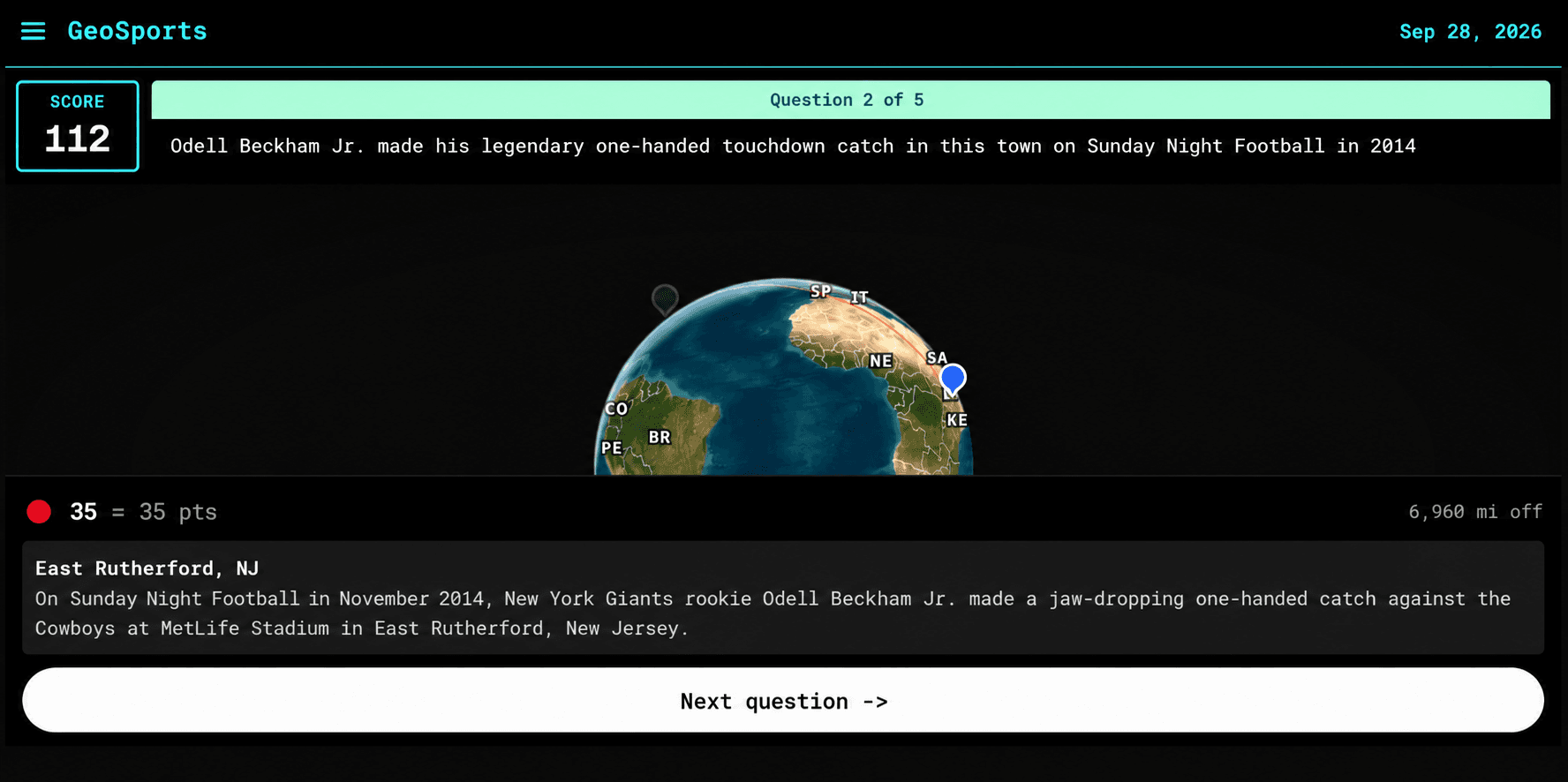
What the daily game loop looks like
A GeoSports prompt, map-based guess, score feedback, and next-question action—the compact loop this case study examines.
Editorial screenshot of the public GeoSports interface. GeoSports product content and interface remain the property of their respective owners; no affiliation or endorsement is implied.
Evidence
Every figure keeps its evidence label so the historical case cannot be confused with an independently verified benchmark.
In brief: these figures are useful context, not an audited benchmark or a promise of reproducible results.
About $40K
Founder interview; exact period, currency, gross/net basis, tax, and fees are undisclosed.
About 700K
Founder statement; calculation window and unique-user method are not public.
About 1,800
Founder statement; active/paying definition, price cohort, platform split, and churn are undisclosed.
About $30K-$35K monthly
Founder statement; gross/net basis, partner share, fill rate, geography, and period are not public.
More than 1M unique players
Founder interview; separate founder post reports 366K plays and 150K peak DAU after the first week.
Web product live and iOS 1.0.3 released September 15
Verified from first-party site and Apple platform records; not proof of business performance.
| Metric | Reported value | Context | Evidence |
|---|---|---|---|
| Monthly revenue | About $40K | Founder interview; exact period, currency, gross/net basis, tax, and fees are undisclosed. | Founder-reported |
| Monthly active users | About 700K | Founder statement; calculation window and unique-user method are not public. | Founder-reported |
| Pro subscribers | About 1,800 | Founder statement; active/paying definition, price cohort, platform split, and churn are undisclosed. | Founder-reported |
| Programmatic advertising | About $30K-$35K monthly | Founder statement; gross/net basis, partner share, fill rate, geography, and period are not public. | Founder-reported |
| First-month reach | More than 1M unique players | Founder interview; separate founder post reports 366K plays and 150K peak DAU after the first week. | Founder-reported |
| Current operation | Web product live and iOS 1.0.3 released September 15 | Verified from first-party site and Apple platform records; not proof of business performance. | Verified |
Cost control
Fixed software is separated from variable usage, advertising, store fees, refunds, taxes, and labor. The largest cost is not necessarily a SaaS subscription.
Domain · AI overage · Map tiles/data · Database and email · Analytics · Content research · Security/legal review · Advertising and store fees
Exact Max 20x price · Domain · Upstash overage · Map services · Payment fees · Current additional processors · Labor
Founder compensation · Ad-network share · Store commissions · Taxes · Chargebacks · Support · Moderation · Legal and insurance
Operating system
Keep the order: choose a narrow behavior and rights-safe content boundary, write the spec, define the smallest daily loop, build a no-install version, add measurement and operational controls, run a private share test, launch where the audience already exists, strengthen the share and return loops, recruit aligned hosts, and monetize only after retention and contribution economics are visible. AI may draft code and explain screenshots, but a human owner must approve architecture, security, data rights, tests, and releases.
In brief: validate the share and return loop before adding hosts, advertising, subscriptions, or a mobile app.
Identify a repeatable interaction that a specific audience already understands without copying protected content or branding.
Turn domain knowledge into explicit states, rules, data, and acceptance criteria before generating code.
Make one complete session valuable without an install, account, or tutorial where possible.
Use replaceable services and keep AI-generated changes reviewable.
Measure the loop before public traffic arrives and protect users from avoidable failures.
Verify that people finish, understand, and voluntarily share the result without founder prompting.
Remove handoff friction between discovery and first play.
Make completion useful socially and give users a clear reason to return tomorrow.
Expand content and reach through people already demonstrating genuine interest.
Add revenue without destroying the free habit or confusing gross revenue with profit.
Tool-by-tool guide
Each component has one job. Original-case tools are kept separate from optional affiliate and expert-execution routes so the historical record stays accurate.
Claude can turn a detailed product idea into a spec, draft implementation, explain screenshots, and help debug bounded issues.
Founder named regular Claude and a Claude Max 20x plan; transcript renders the name inconsistently.
Review Claude CodeVercel hosts the web app, previews changes, and supports fast rollback and traffic-aware operations.
Founder-named and currently disclosed in the privacy policy.
Review Vercel pricingMapLibre renders the interactive globe or map where players place guesses.
Founder-named; tile and geographic-data providers were not disclosed.
Review MapLibre docsUpstash Redis can hold fast-changing leaderboard, session, or statistics data.
Founder-named and currently disclosed in the privacy policy.
Review Upstash RedisA spreadsheet can act as a temporary reviewed queue for daily questions and answers.
Founder-named for questions; exact permissions and plan were not disclosed.
Review Google SheetsStripe can collect web payments and manage recurring subscription billing.
Founder-named and current terms say GeoGames Pro is billed through Stripe on the web; mobile app purchases are a separate platform path.
Review Stripe pricingPostHog can measure completion, sharing, return, and feature usage when configured with minimized data.
Named in the current privacy policy, not in the founder's interview-era six-tool summary.
Review PostHogPortfolio
Original Tools preserve what the case reported. Current Portfolio reflects present workflow fit. A Required slot can remain empty when evidence is not strong enough to name a Current Primary.
A comparable-product insight is useful only when the team documents what is original, licensed, or prohibited.
It matches the reported product family, but start with the lowest-capacity plan that fits measured workload.
Important condition: Human owner retains architecture, testing, security, and release approval.
It matches the founder-named stack and current privacy disclosure.
It directly covers the disclosed interaction layer.
Important condition: Verify map style, tiles, location data, attribution, and usage rights separately.
A spreadsheet is enough for a tiny reviewed queue; migrate when permissions, audit, localization, or volume outgrow it.
It matches the reported role and can start small, but viral traffic requires explicit budgets and fallbacks.
Neon is named in the current privacy policy; the historical database and schema are unknown.
It is currently disclosed, but a new team should choose only after defining the minimum event and privacy model.
Use after free-loop retention is measured; web and app-store entitlements need reconciliation.
Playwire is currently disclosed, but a new product should not add ad complexity before repeat usage, consent, and net economics are proven.
Replacement choices
These are comparison directions, not automatic recommendations. Replacing one component can change integrations, operating burden, attribution quality, or the economics of the whole workflow.
In brief: choose by operating burden, data rights, reliability, and economics—not by a tool's tutorial popularity.
Lower-cost / direct path
Claude Pro or pay-as-you-go use for bounded tasks
Specialized path
Claude Max or another repository-focused coding agent for sustained sessions
Trade-off
Higher capacity reduces interruptions but does not replace tests, security review, or product judgment.
Lower-cost / direct path
Vercel Hobby for a personal non-commercial prototype
Specialized path
Vercel Pro, Cloudflare, or another production platform with explicit observability and limits
Trade-off
Choose from traffic shape, team controls, runtime needs, and predictable overage—not tutorial convenience alone.
Lower-cost / direct path
A permissioned spreadsheet
Specialized path
A small CMS or database-backed editorial workflow
Trade-off
Spreadsheets are fast but weak for granular roles, audit history, localization, and complex validation.
Lower-cost / direct path
A relational database with indexed score tables
Specialized path
Managed Redis for hot ranks, counters, TTLs, and rate limits
Trade-off
Adding a cache improves latency but creates consistency, eviction, recovery, and cost-control work.
Lower-cost / direct path
No monetization during validation
Specialized path
Ads, web subscription, app-store purchases, sponsorships, or a blended model
Trade-off
Each revenue layer changes privacy, UX, reporting, fees, moderation, and entitlement complexity.
| Slot | Lower-cost / direct path | Specialized path | Replacement trade-off |
|---|---|---|---|
| AI build assistant | Claude Pro or pay-as-you-go use for bounded tasks | Claude Max or another repository-focused coding agent for sustained sessions | Higher capacity reduces interruptions but does not replace tests, security review, or product judgment. |
| Deployment | Vercel Hobby for a personal non-commercial prototype | Vercel Pro, Cloudflare, or another production platform with explicit observability and limits | Choose from traffic shape, team controls, runtime needs, and predictable overage—not tutorial convenience alone. |
| Question operations | A permissioned spreadsheet | A small CMS or database-backed editorial workflow | Spreadsheets are fast but weak for granular roles, audit history, localization, and complex validation. |
| Leaderboard state | A relational database with indexed score tables | Managed Redis for hot ranks, counters, TTLs, and rate limits | Adding a cache improves latency but creates consistency, eviction, recovery, and cost-control work. |
| Monetization | No monetization during validation | Ads, web subscription, app-store purchases, sponsorships, or a blended model | Each revenue layer changes privacy, UX, reporting, fees, moderation, and entitlement complexity. |
Transferability
Guardrails
AI-generated code, sports and trivia rights, third-party map data, sudden traffic spikes, user accounts, leaderboards, advertising trackers, subscriptions, and a potentially young audience create security, privacy, reliability, consumer-protection, content, and platform-policy risks. Viral reach is not evidence of durable retention or profitable unit economics.
Mitigation: Use least privilege, server-side secrets, tests, dependency scanning, rate limits, code review, preview environments, monitoring, and rollback before public traffic.
Mitigation: Create original content, keep source and license records, preserve map attribution, review trademarks and media rights, and maintain a correction/takedown path.
Mitigation: Maintain a processor/data-flow register, region-aware consent, retention limits, access controls, tested deletion, vendor agreements, and special review for children or young audiences.
Mitigation: Load-test the hot path, set budgets and alerts, cap expensive work, use TTLs and queues, define degraded modes, back up durable data, and rehearse recovery.
Mitigation: Separate cohorts, record referrers and dark-social uncertainty, compare assisted and unassisted users, and require repeat behavior after the initial spike.
Mitigation: Stage monetization behind retention evidence, cap ad load, label paid features, measure churn and performance guardrails, and keep cancellation and entitlement behavior testable.
Mitigation: Use a written brief, independent sources, rights checks, review and correction queues, disclosure rules, and a kill switch for scheduled content.
Transparency
Prepared September 28, 2026 from the direct Starter Story founder interview, current GeoSports product and policy pages, Apple App Store and lookup records, a dated founder launch post, and current official vendor documentation. The source publication date, prototype date, private/public launch window, interview-relative result period, mobile release, and current operating evidence are recorded separately. All revenue, traffic, subscriber, audience, attribution, and build-time claims remain Founder-reported unless explicitly marked Verified. The title's eight-hour claim is not repeated as a settled fact because the transcript says work continued the next day and another account says fourteen hours. Current vendor pricing is a reference scenario, not a reconstruction of founder invoices. The original stack and AI LinkBase's current recommendations remain separate. No private analytics, source repository, billing export, ad-network statement, processor reconciliation, security audit, or legal opinion was available.
Source case: I built this website in 8 hours with Claude. Now it makes $40K/month, Starter Story, September 27, 2026. Short excerpts are used only where necessary; this page is an original workflow analysis.
Transferable lesson
GeoSports validates a sequence, not a tool: own a narrow behavior, write the specification, ship the smallest no-install loop, test voluntary sharing, then add hosts, advertising, and subscriptions only after retention is visible.
That sequence can transfer. The outcome cannot. Frank Michael Smith's audience of more than four million followers and years of sports-content experience were material distribution advantages that a new team should not assume it can reproduce.
Where to start: write the first operating spec before opening a code editor. It should define the core loop, scoring, failure states, content and rights boundary, and what is explicitly out of scope.