July 31, 2026. In an AI industry first, two top-tier video models launched on the same day: ByteDance's Seedance 2.5 and MiniMax's H3. One pushes closed-source industrial-grade 4K/30s generation with 50-reference input; the other goes open-weight, multimodal, and 2K at a fraction of the cost. We synthesized every available head-to-head test — from Huxiu's three-round PK to the Atlas Cloud multi-shot character-consistency benchmark — to give you a single-source verdict on which model fits which AI video workflow.
TL;DR
Neither model decisively beats the other. In Huxiu's three-round head-to-head test, MiniMax H3 and Seedance 2.5 tied — H3 won on cinematic quality and spatial coherence ("knows what the film should look like"), Seedance 2.5 won on precise shot-by-shot instruction execution ("knows what the director asked"). H3 is $0.8/sec for 2K + open weights soon; Seedance 2.5 is 4K/30s native + 50-reference input but at an estimated 2.5–5× premium. For budget-conscious production teams and post-production editing, H3 is now the go-to. For long-form industrial workflows needing 30-second continuous takes and region-level editing, Seedance 2.5 leads.
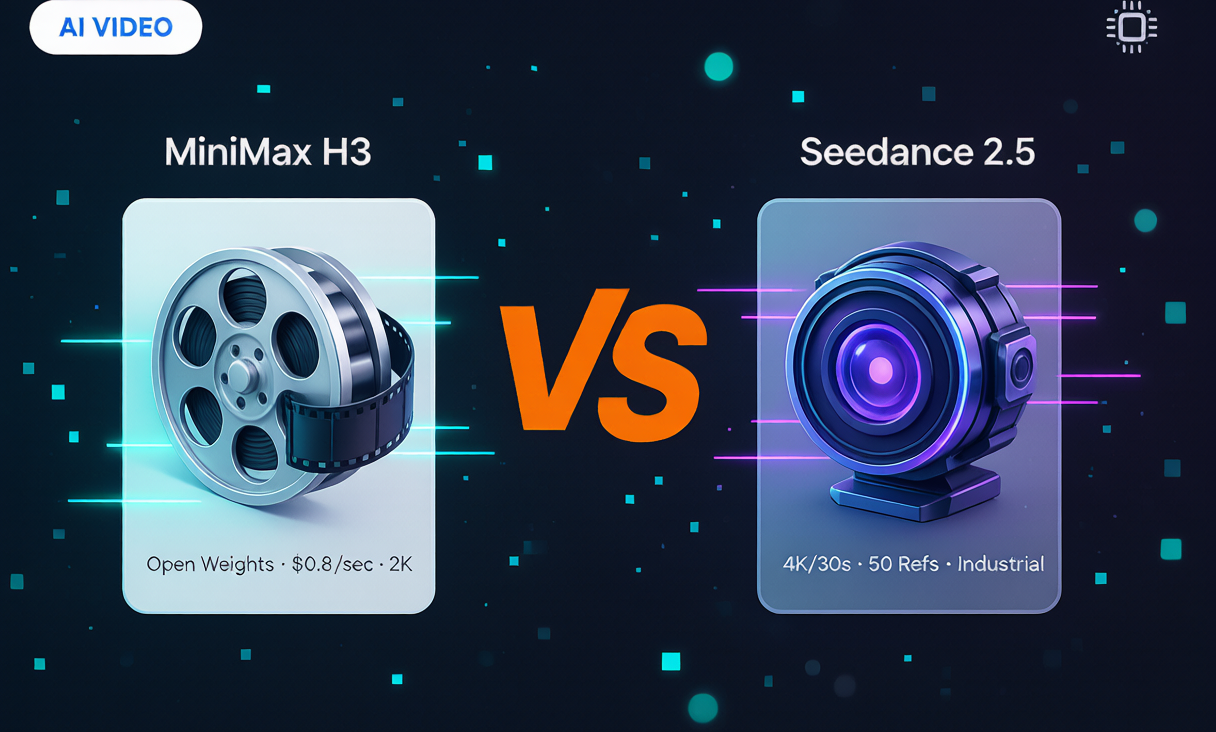
MiniMax H3: What It Brings to the Table
Before diving into the comparison, let's establish what MiniMax H3 actually offers. It's a lightweight, fully multimodal video model that accepts text, images, audio, and video as input—and outputs complete videos with integrated visuals, environmental sound, dialogue, or music in a single pass.
| Feature | MiniMax H3 | Seedance 2.0 | Seedance 2.5 (NEW) |
|---|---|---|---|
| Max Video Length | 5–15 seconds | 5–15 seconds | 30s native (beta: 180s) |
| Max Resolution | 2K native | 1080p | 4K native, 10-bit |
| Reference Inputs | 12 mixed files | ~4 images | 50 mixed (30+10+10) |
| Max Prompt | 7,000 characters | ~2,000 characters | Not disclosed |
| Audio Output | Native stereo | Silent | Native sync + 11 languages |
| Editing Granularity | Clip-level editing | Limited | Region-level redraw |
| Price (per second) | 2K: ¥0.80/sec (~$0.12/sec) | 1080p: ~¥2.00/sec (~$0.29/sec) | TBA (est. ≥¥2.00/sec, ~$0.29+/sec) |
| Open Weights | ✓ Announced | ✗ | ✗ |
| AA I2V Elo (Jul 31) | 1,185 (#3) | 1,196 (#1) | Not yet ranked |
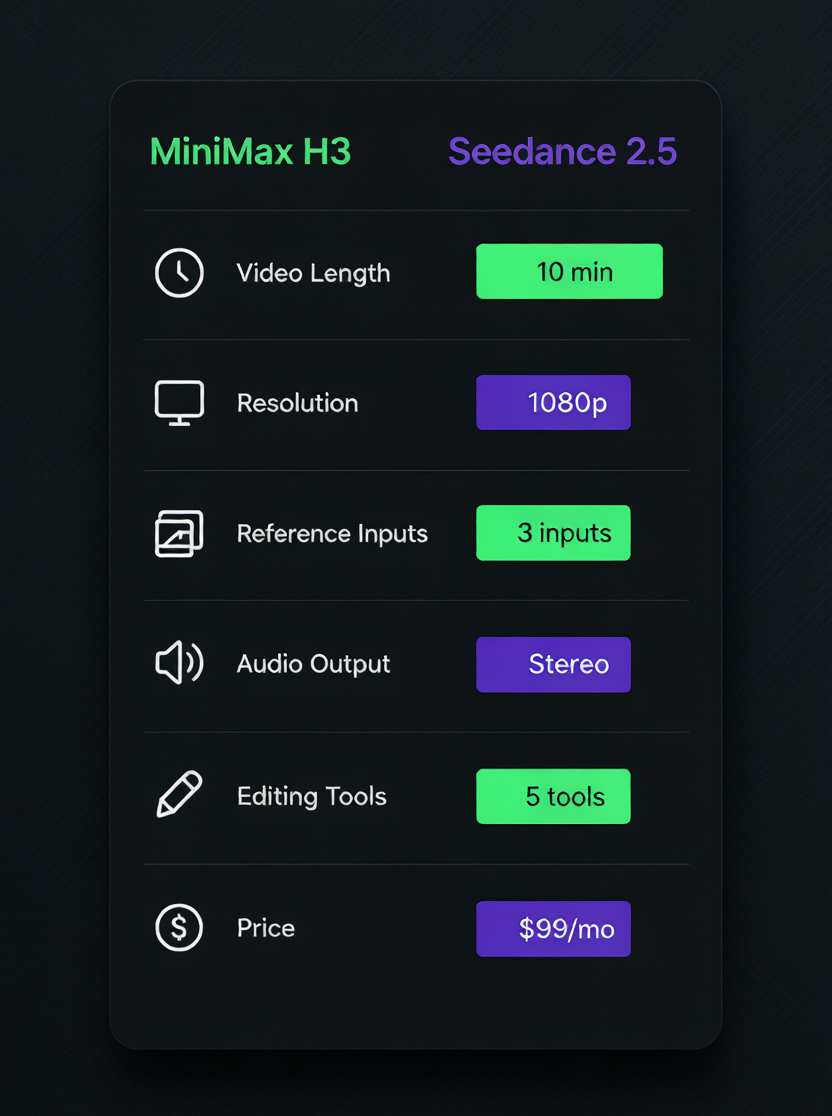
The three models sit in three distinct tiers: Seedance 2.0 (previous-gen SOTA, still #1 on Artificial Analysis I2V), MiniMax H3 (open-weight challenger, #3 on AA within 4 days of launch), and Seedance 2.5 (next-gen closed-source with 30s/4K, not yet on AA leaderboard). Below, we run through each creative scenario, first using the widely-available 2.0 as the baseline, then present the independent Huxiu vs Seedance 2.5 head-to-head.
⚠️ Important: Two Different Comparisons Below
Scenes 1–6 below are based on community tests from early August using Seedance 2.0 as baseline — these were the tests available when both models launched. The Huxiu section (after Scene 6) is the first independent head-to-head of H3 vs Seedance 2.5, published August 1 by Silicon Star Pro on Huxiu. Read both to form a complete picture.
The 6-Scene Head-to-Head Comparison
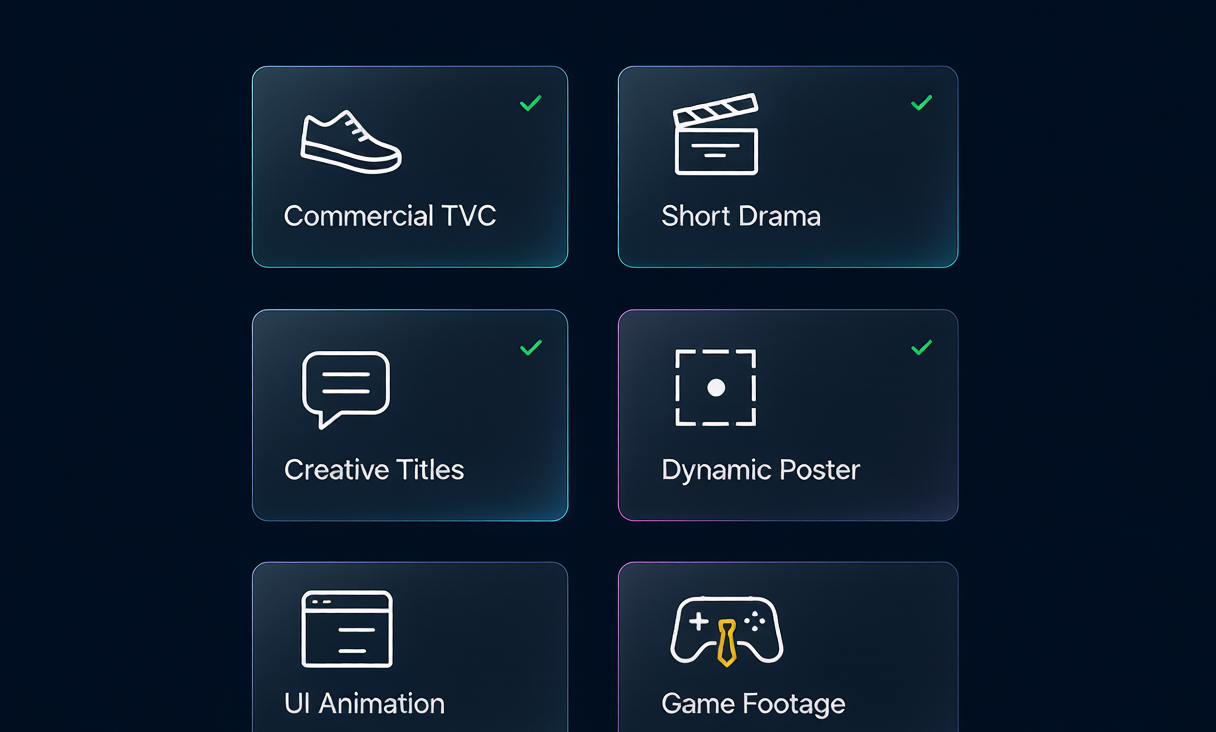
Scene 1: Commercial TVC — Running Shoe & Snack Ads
Test: Multi-shot product launch video with branded text, product close-ups, material reveals, and branded outro card.
MiniMax H3: In the AERO 07 running shoe test, H3 demonstrated a remarkably complete understanding of product structure. It correctly rendered the shoe's silver-black-fluorescent green colorway across all shots, executed a clean "deconstruction → material showcase → reassembly → brand outro" narrative arc, and preserved the "AERO//07" and "GRAVITY OFF" text on the black outro card without a single typo. In the AEROFOAM X1 cushioning test, H3 was the only model to correctly execute the specified "compress once, rebound once" mechanics with visible midsole deformation and recovery. Native ambient audio and subtle product sound effects were generated in-sync with the visual.
Seedance 2.0: In the same AERO 07 test, Seedance altered the side-profile exploded view into a top-down orthographic structure, and some silver components morphed into decorative side wings. The micro-detail segment lingered heavily on a single texture composition for ~4 seconds (6.7–10.7s), making the pacing feel sluggish. In the AEROFOAM X1 test, Seedance entirely missed the critical "compress and rebound" action—arguably the core selling point of the product—and collapsed a four-part storyboard into essentially "shoe sole macro + parameter page."
Verdict: H3 Wins
H3 completed more script content across product structure, text rendering, multi-shot structure, and sound. Seedance missed core action beats that would fail a client review.
Scene 2: Short Drama — Real-Human Performance with LibTV Skills
Test: Leveraging MiniMax LibTV's pre-built Skills combined with H3 to generate realistic short-form drama sequences with consistent characters and natural acting.
MiniMax H3 + LibTV: When paired with LibTV's Short Drama Skill, H3 produced sequences with surprisingly solid character consistency and voice preservation. Scene quality was high—props, set design, and lighting all felt production-grade, not AI-generated. The real game-changer was LibTV's node-based canvas: every character, scene, and shot existed as an independent node with its own editable prompt. If a single shot didn't work, you could regenerate just that one—no need to redo the entire sequence. With H3's low credit cost, testers reported comfortably batch-generating 4–8 variants per shot without budget anxiety.
Seedance 2.0: Seedance was not directly tested in this workflow configuration, as LibTV Skills are natively optimized for H3. In standalone short-drama generation, Seedance can produce good single shots but lacks the node-based iterative refinement that makes H3 + LibTV a production pipeline rather than a slot machine.
Verdict: H3 + LibTV Wins (Workflow Advantage)
The combination of per-node editing, low batch-generation cost, and Skill-based automation makes H3 the practical choice for short-drama production teams.
Scene 3: Creative Title Sequence — Animation & KPOP MV
Test: 15-second sci-fi anime title sequence with complex compositing, plus a real-human KPOP MV with dynamic on-screen lyrics.
MiniMax H3: For "NEON OVERDRIVE"—a retro Japanese-anime-style title sequence with collage, halftone dots, chromatic offset, torn-paper edges, speed lines, and bold geometric color blocks—H3 delivered results that surprised even the tester. Despite the prompt specifying no 3D CGI or live-action, H3 maintained stylistic consistency through rapid cuts. All English credits ("A FILM BY ELIAS NORTH," "STARRING MIRA VALE," "MUSIC BY JUNO MERCER," "NEON OVERDRIVE") appeared correctly, once each, with no garbled text. The KPOP MV test pushed even further: on-screen lyrics like "PINK LIGHT," "ONE TOUCH," "CHROME HEART" appeared as oversized dynamic text that overlapped characters and broke frame edges—every word spelled correctly through fast cuts and complex compositing. This level of text stability in motion is exceptionally rare in AI video generation.
Seedance 2.0: Not directly benchmarked in this specific creative title test configuration. However, in general multi-shot creative workflows, Seedance tends to produce strong individual frames but can struggle with text consistency and complex compositing instructions across rapid cuts—areas where H3's 7,000-character prompt comprehension shows its advantage.
Verdict: H3 Wins
H3's text stability, style adherence, and ability to keep complex compositing rules consistent across 15-second sequences set a new bar for creative title work.
Scene 4: Dynamic Poster — Product Showcase with Restrained Motion
Test: Turning a static shampoo product poster into a dynamic social-media-ready video—with the critical requirement that product text remain sharp and readable throughout.
MiniMax H3: With just the prompt "make a dynamic poster," H3 produced a restrained, tasteful animation where each poster element appeared sequentially. The product name and tagline remained razor-sharp through the entire sequence—no blur, no morphing, no flying-off. This selective restraint is what separates production-ready output from flashy AI artifacts: H3 understood that a dynamic poster for social media should enhance the layout, not obliterate it.
Seedance 2.0: Many AI video models (Seedance included) tend to over-animate poster-type content, introducing excessive camera movement or element drift that defeats the purpose of a "dynamic poster"—which should still read as a poster. H3's model-level understanding of "appropriate motion restraint" is a differentiator here.
Verdict: H3 Wins
Text stability + motion restraint = production-ready dynamic posters. H3 knows when to hold back, and that matters more than raw motion capability for this use case.
Scene 5: UI Animation — Website Product Page with Scrolling & Hover Effects
Test: A high-end headphone product page (SONORA) with scrolling, sticky positioning, hover interactions, and multi-section feature cards—all generated from a single product image.
MiniMax H3: This might be H3's single most impressive demo. From just one product image and a prompt describing a dark-themed premium website with tilted oversized typography, dynamic carbon-fiber and acoustic mesh backgrounds, and a one-shot scrolling experience, H3 produced a fully coherent UI animation video. The navigation bar stayed fixed. The headphone product smoothly scrolled and repositioned with a sticky effect. Feature cards for "Noise Cancellation," "Sound Quality," and "Battery Life" appeared sequentially. Button hover states triggered local scale and color-inversion effects. Every single UI text element—headings, body copy, button labels, spec numbers—was generated by H3 itself and remained stable through the full motion sequence. For anyone who's worked with AI video, keeping dozens of text elements correct through complex motion is borderline miraculous.
Seedance 2.0: Not tested in this specific UI configuration. However, UI animation with dense text and precise layout logic is currently beyond the reliable capability of most AI video models, including Seedance. H3's performance here is a genuine technical breakthrough.
Verdict: H3 Wins (Technical Breakthrough)
Self-generated UI text, scroll logic, hover interactions, and layout consistency from a single image. This opens a new category of AI video use case for product marketing teams.
Scene 6: Game Footage — AAA Sci-Fi Equipment Demo with HUD Overlay
Test: A 15-second AAA game equipment showcase with character, shield gear, UI overlay, and cinematic environment—all generated from 4 reference images (character, equipment, UI style, environment) with no game-screenshot references.
MiniMax H3: H3 handled the four reference images cohesively: scene, character, equipment, and UI all entered the same video sequence with controlled timing. The training shield was clearly shown before being replaced by the TIDE SHIELD on the left forearm. Shield attachment was clean—no floating, no arm penetration, no drift to the right hand. The HUD overlay with "TIDE//WARDEN," "EPIC DEFENDER," and "EQUIP" text appeared correctly. The city environment loaded with scanline effects matching the prompt. H3 also demonstrated strong aesthetic intuition for game UI styling. One nitpick: the EQUIP button stayed highlighted too long instead of pulsing once and stabilizing.
Seedance 2.0: Seedance produced some genuinely impactful shots—particularly the shield equipment attachment phase, where twin-ring mechanical connectors and energy-core ignition created a strong visual punch. However, the loading screen cut short (~1.25s vs. the specified 3s), and the character's armor design shifted between shots (layered plating → hexagonal chest plate). The model prioritized individual shot impact over narrative consistency.
Verdict: Tie (Different Strengths)
Seedance creates more visually striking individual shots with strong equipment-attachment physics. H3 delivers better multi-reference coherence and narrative flow. Choose based on whether priority is single-shot impact or sequence-level consistency.
Huxiu Independent Benchmark: MiniMax H3 vs Seedance 2.5 — Three-Round Head-to-Head, Wildly Different Personalities
Source: Silicon Star Pro on Huxiu, published August 1, 2026. This is the first independent head-to-head of H3 vs Seedance 2.5 using identical prompts, reference images, and reference videos across three real-world tests.
Round 1: Fantasy Short Film — Museum Heist with Dinosaur Skeleton
Test: 500-word director-level prompt — one-take shot through a museum at midnight, fox runs, T-Rex awakens, camera orbits 270°, climax with nose-touch
MiniMax H3: Delivered cinematic quality immediately. The fox, T-Rex skeleton, display cases, and glass dome stayed in one coherent space throughout — no spatial drift despite the complex camera moves. Ground reflections were correctly synchronized. The fox's fur color, body shape, and tail remained consistent. The ending — fox touches T-Rex's nose, lights turn on sequentially, camera pulls back to wide — executed as one continuous take. But: Blue whale skeleton fly-through completely missing; low-angle side tracking shot became rear follow; fox never actually ran.
Seedance 2.5: Nailed almost every camera instruction H3 missed. The lens passed through the whale skeleton ribs, tracked alongside the fox, swept past pillars, and the fox genuinely ran. Ground reflections were directionally correct. But: Completely ignored the "one-take" requirement — each shot looked like it was filmed per the storyboard but cut together they didn't feel like the same museum. In the final wide shot, stone pillars vanished and skeletons became living animals with skin and fur.
Key insight: When a task is too complex to complete entirely, H3 chooses to omit (prioritizing spatial coherence), while Seedance 2.5 chooses to attempt everything (prioritizing instruction completeness).
Round 2: Commercial Ad — Beverage Can with Dancer + 3D Transition
Test: Energy drink ad — dancer emerges from can, triggers stage effects, returns to packaging, branded outro
MiniMax H3: Preserved most key elements of both products. The dancer emerged from the can → triggered the stage → returned to packaging, creating a complete creative loop. Opening can scan light, water droplets, bubbles, popping sound, and drum beats synced to visual rhythm. Ending ad copy was crisp and accurate. But: Dancer didn't clearly execute the backslide; blue liquid ripples missing; ending camera pushed to the wrong product.
Seedance 2.5: Missed some of the polished commercial lighting that makes H3's output look like a finished ad. More accurately executed the 2D→3D transition and correctly pushed the final shot to the specified right-side product. But: Backslide also became a few small running steps; visual polish slightly below H3.
Verdict: Tie
At first glance, H3 looks more like a finished ad. Shot-by-shot against the storyboard, Seedance 2.5 completed more of what was asked.
Round 3: Robot Training Data — 4-Camera Ego Multi-View
Test: Generate synchronized 4-camera ego data (head, left wrist, right wrist, overhead) of a dual-arm robot performing pick-and-place with a red cube
Both models failed. H3 generated all four views from the same perspective. Seedance 2.5 showed some perspective differences but neither the robot body nor motion matched the prompt requirements. Content video just needs to "look continuous" — robot training data requires frame-level spatial, temporal, contact, and camera-geometry constraints. Today's general-purpose video models can shoot movies, but reliably simulating the physical world is still a very thick wall away.
Huxiu's Final Verdict: Two Philosophies, One Tier
MiniMax H3 "knows what the film should look like" — prioritizes cinematic quality, spatial coherence, and overall aesthetic. When capacity runs out, it chooses to omit rather than hallucinate.
Seedance 2.5 "knows what the director asked" — prioritizes shot-by-shot instruction execution, precise camera moves, and timeline control. When capacity runs out, it attempts everything but may lose spatial consistency.
The Price Factor: Why It Changes the Equation
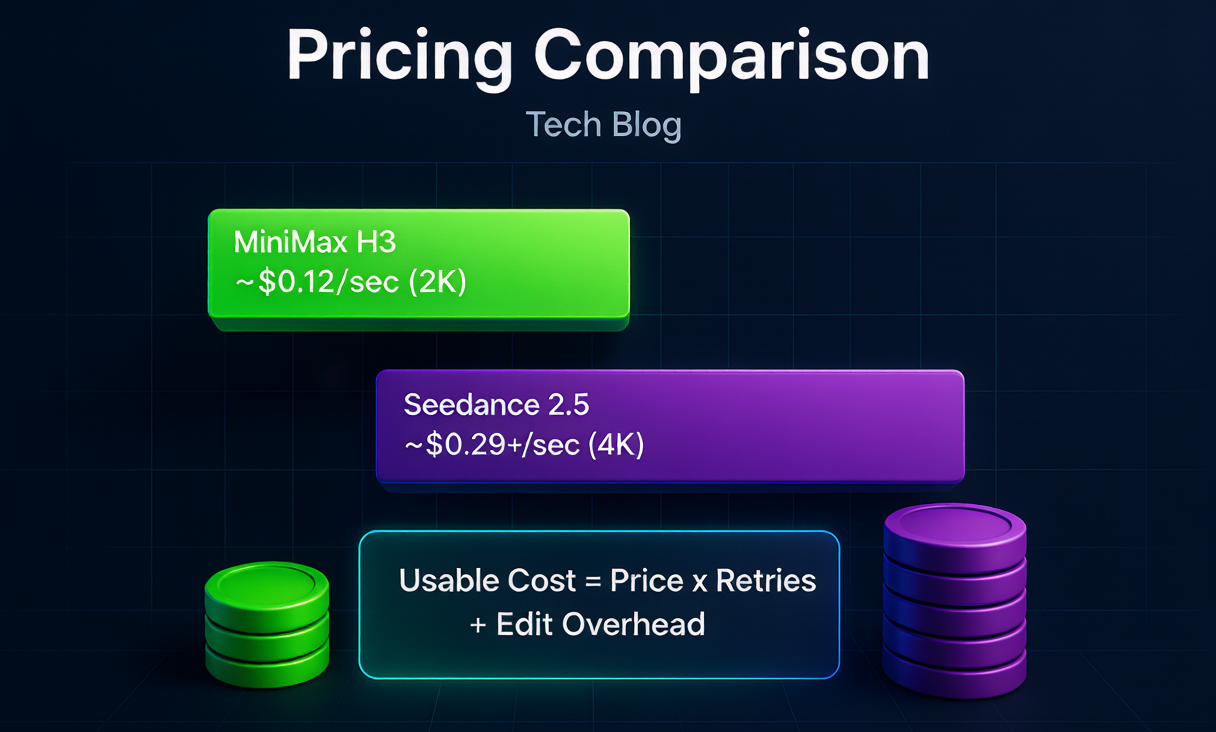
Model quality is only half the story. Production cost determines whether a model actually gets used at scale—especially when comparing against other top AI video generators. Here is the math:
| Cost Factor | MiniMax H3 | Seedance 2.5 (est.) | Winner |
|---|---|---|---|
| Per-Second Price | $0.12/sec @ 2K | Est. ≥$0.29/sec (based on 2.0) | H3 (2.5–5× cheaper) |
| Per-Pixel Efficiency | 2K at lower cost | 4K at premium cost | H3 for 2K workflows |
| Audio Generation | Included (stereo) | Included (11 languages) | ~Tie |
| Retry Efficiency | Lower (better prompt adherence) | Higher (complex scenes → more rolls) | H3 |
| Open Weights | ✓ Self-host → near-zero marginal | ✗ API-only | H3 at scale |
The Real Production Cost Formula
Usable asset cost = (single-generation price × average attempts) + manual editing & review overhead.
H3 lowers both variables: cheaper per generation and fewer retries due to better multi-reference comprehension and text stability.
Scene-by-Scene Scorecard
| Scene | MiniMax H3 | Seedance 2.0 | Winner |
|---|---|---|---|
| 1. Commercial TVC | ★ ★ ★ ★ ★ Complete narrative, text-accurate, native audio | ★ ★ ★ ☆ ☆ Missed key action beats, pacing issues | H3 |
| 2. Short Drama | ★ ★ ★ ★ ☆ Node-based editing + low batch cost | — Not tested in this workflow | H3 + LibTV |
| 3. Creative Titles | ★ ★ ★ ★ ★ Exceptional text stability, style consistency | — Not benchmarked | H3 |
| 4. Dynamic Poster | ★ ★ ★ ★ ★ Text-perfect, motion-restrained | ★ ★ ★ ☆ ☆ Tends to over-animate | H3 |
| 5. UI Animation | ★ ★ ★ ★ ★ Breakthrough text + interaction fidelity | — Not tested | H3 |
| 6. Game Footage | ★ ★ ★ ★ ☆ Great multi-ref coherence, minor timing flaw | ★ ★ ★ ★ ☆ Stronger individual shot impact | Tie |
When to Choose MiniMax H3
- Commercial & brand video production — Product structure preservation and brand-text accuracy are paramount.
- Post-production & VFX work — H3 currently leads AI video editing (ranked #1 on Artificial Analysis).
- Multi-reference workflows — When you need character, product, scene, UI, audio, and motion references in one context.
- Budget-conscious teams — ~2.5× cheaper per second, with fewer retries needed.
- Text-heavy video projects — Dynamic posters, UI demos, lyric videos, branded content with on-screen copy.
- Short drama production — Node-based LibTV pipeline enables per-shot iteration at viable batch sizes.
When Seedance 2.5 Leads
- 30-second continuous takes — Seedance 2.5's native 30s single-pass generation (no stitching) is unmatched for ad spots, product demos, and narrative beats that need one continuous scene.
- Massive reference input — 50 multimodal references in one job (30 images + 10 videos + 10 audio) is transformative for complex multi-character, multi-location shoots.
- Region-level editing — Swap a product on a table or replace a background while preserving motion, lighting, and the rest of the frame. H3 edits at clip-level only.
- Native 4K / 10-bit output — If your pipeline delivers broadcast-ready masters without upscaling, Seedance 2.5 saves an entire post-production step.
- Multi-round extension — Generate additional shots that maintain character, environment, and rhythm consistency. The demo film "The Missing Sock" was 3.5 minutes, all generated by 2.5.
Availability note: Seedance 2.5 is rolling out on Jimeng AI, Doubao Pro, Coze, and Xiaoyunque, with API access coming via Volcano Ark. As of August 4, 2026, third-party platform availability varies — check before planning production pipelines.
Bottom Line: Which One Should You Choose?
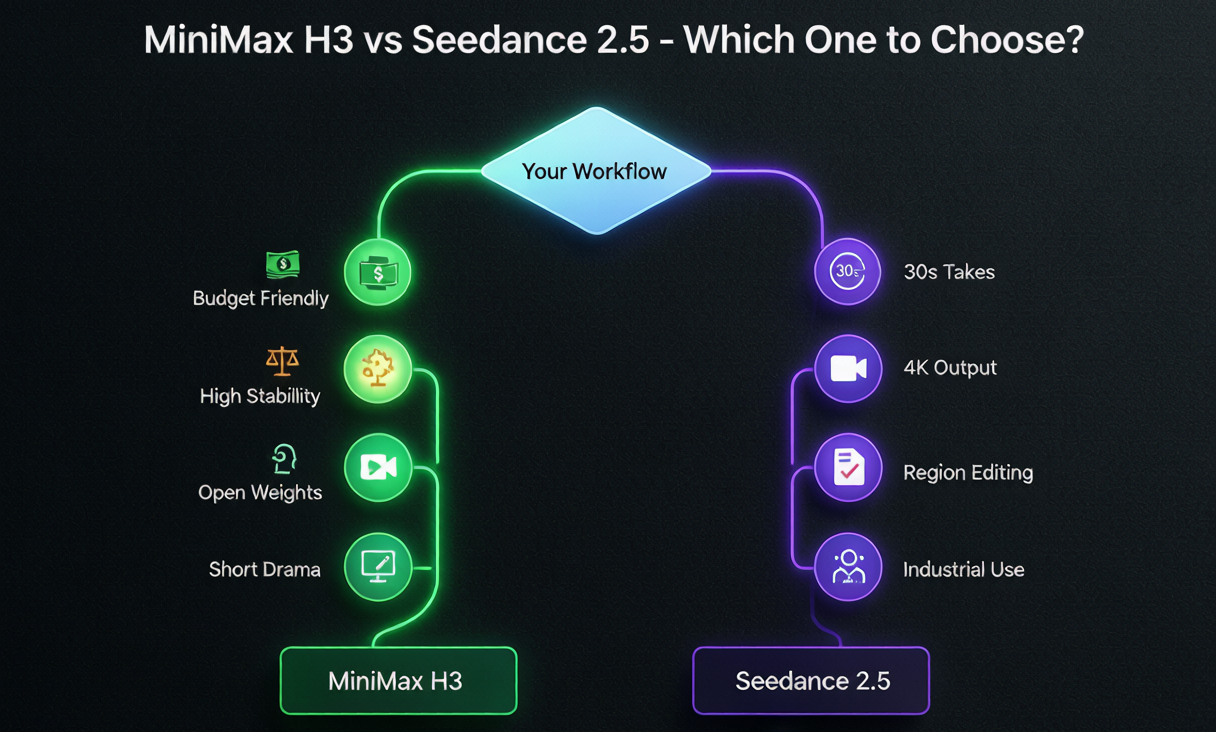
After synthesizing both the six-scene community tests and the independent Huxiu head-to-head, the verdict is clear: this is not a winner-takes-all race — it's a fork in the road.
Choose MiniMax H3 if: You prioritize cost efficiency (~$0.12/sec for 2K), need open weights for self-hosting, rely on multi-modal reference comprehension (character + product + audio in one context), or work in commercial ads / short drama / post-production editing. H3 currently ranks #1 on Artificial Analysis's video editing leaderboard and #3 on I2V generation — after just 4 days live.
Choose Seedance 2.5 if: You need 30-second native single-pass generation, native 4K/10-bit masters, 50-reference-input complexity, region-level precision editing, or multi-round extension for minute-plus narratives. It's the industrial-grade tool for agencies and film teams that need maximum control and output fidelity — at a premium price.
Choose both if: Your production pipeline can use H3 for rapid iteration, concept exploration, and cost-sensitive assets, then graduate to Seedance 2.5 for final 4K master renders and long-form sequences. The two models' "personalities" — H3's aesthetic coherence vs. Seedance 2.5's instruction precision — are complementary, not redundant.
The AI video generation landscape just had its first real "fight night." Two top-tier models, two opposing philosophies, one launch day. See our full side-by-side comparison page with feature table, pricing breakdown, and use-case verdicts — or browse our complete AI video tools directory for more options.
Try MiniMax H3
Desktop client: hub.minimaxi.com (new users get 3 free generations) · Web: hailuoai.com · Also available on pixpix and LibTV with Skill-based workflows.
Note: All test results in this article are based on publicly available comparisons and reviews from the AI creator community. Individual results may vary based on prompt quality and reference material.
Related Reading
MiniMax H3 vs Seedance — Full Comparison
Side-by-side feature table, pricing breakdown, and use-case verdict.
Best AI Video Generators 2026
Compare 10+ AI video tools by use case, pricing, and output quality.
Browse All AI Video Tools
Explore our complete directory of AI video generation platforms.
Compare AI Tools Side-by-Side
Stack up pricing, features, and specs across any two AI tools.
How We Review AI Tools
Understand our testing methodology and rating framework.
Our Methodology
This is a B-level framework review. We synthesized publicly available testing results from multiple independent AI video creators who conducted side-by-side comparisons using identical prompts and reference materials. We evaluated each model on six dimensions: product-structure fidelity, text stability, multi-shot narrative coherence, motion naturalness, audio integration, and price-to-performance ratio. Learn how we review AI tools →
See also: Best AI Video Generators 2026 · Browse all AI video tools · Compare AI Tools